Why Now Is the Time to Kickstart Your ABM Strategy for 2026
Over the past five years, marketing has undergone a fundamental reset. During the pandemic boom, budgets expanded quickly as companies raced to capture digital demand. Today, that environment has shifted. Average marketing budgets are now roughly 25% lower than those peak levels — while expectations for pipeline, revenue impact, and accountability continue to rise.
Marketing leaders are being asked to do more with less. More efficiency. More alignment with sales. More measurable impact. And fewer wasted dollars.
This is precisely where Account-Based Marketing (ABM) earns its place at the center of modern B2B growth strategies.
The efficiency imperative
Traditional demand generation casts a wide net. It can drive volume, but it often lacks precision. ABM flips the model. Instead of chasing anonymous leads, ABM focuses marketing and sales resources on the accounts that matter most — the ones with the highest potential revenue and strongest fit.
A proper ABM strategy allows organizations to:
• Identify and prioritize high-value target accounts
• Understand where each account sits in the buying journey
• Deliver tailored messaging and content based on intent
• Align sales and marketing around shared account goals
• Measure marketing’s direct contribution to revenue
The result is a more efficient growth engine — one that replaces guesswork with clarity and replaces volume with velocity.
Visibility across the entire funnel
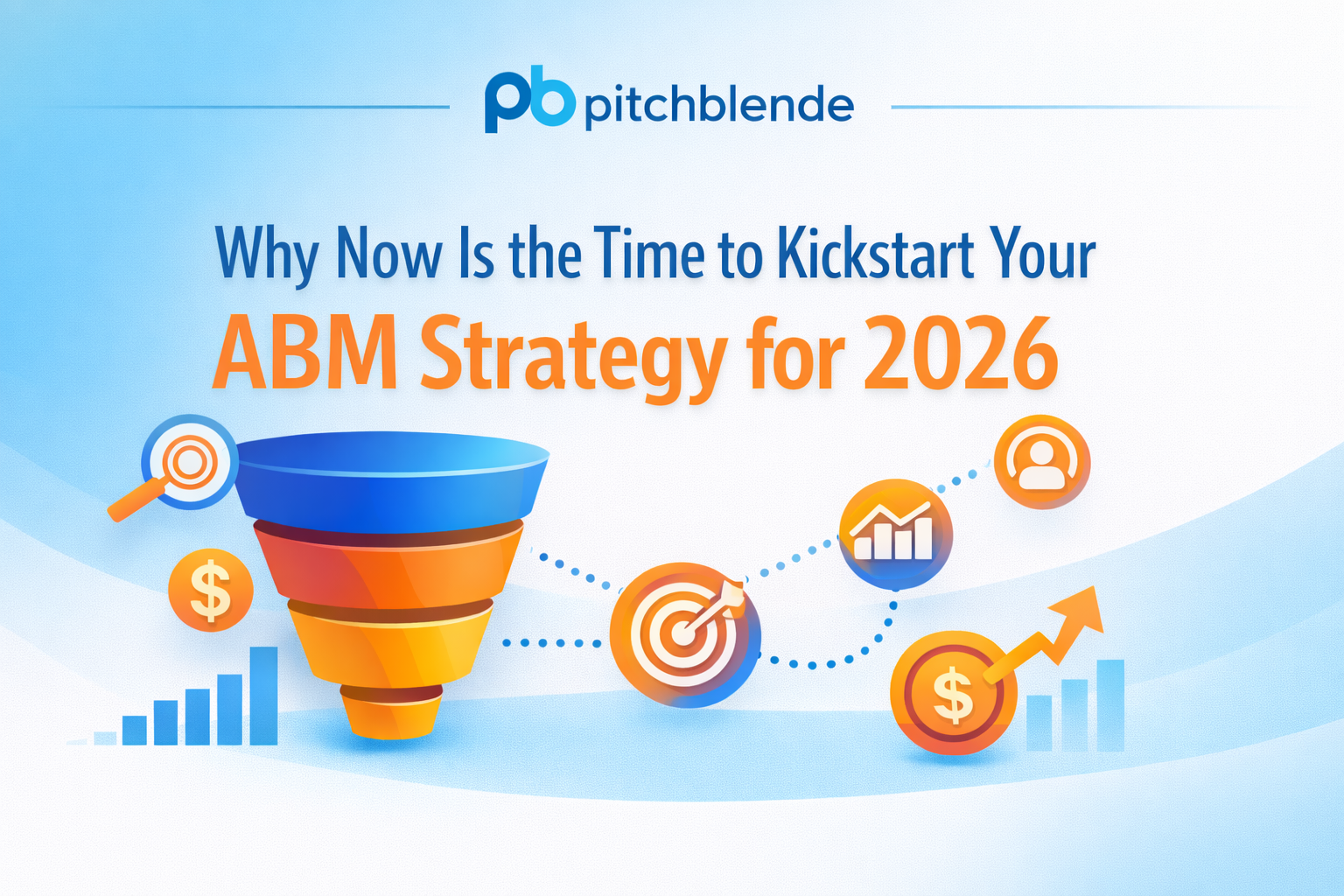
One of the most powerful aspects of ABM is funnel intelligence. Rather than measuring isolated campaign performance, ABM provides a holistic view of account progression — from awareness to engagement to pipeline to closed revenue.
This visibility allows marketing teams to:
• See which accounts are engaging
• Understand what content is resonating
• Identify where accounts stall
• Adjust tactics in real time
When budgets are tight, this level of insight is no longer a luxury. It’s a requirement.
Turning strategy into execution
While ABM is conceptually simple, executing it at scale requires the right data, tooling, and orchestration. That’s why we partner with Demandbase to help bring ABM strategies to life.
Demandbase enables:
• Intent-driven account identification
• Account and persona-level personalization
• Cross-channel orchestration
• Real-time engagement insights
• Clear revenue attribution
Combined with pitchblende’s strategy, creative, and activation capabilities, this creates an end-to-end ABM engine — from defining your ICP and target account list to activating personalized campaigns that drive measurable pipeline impact.
Why start now for 2026?
ABM is not a switch you flip overnight. The strongest programs are built on solid foundations: ICP clarity, target account definition, messaging frameworks, data hygiene, sales alignment, and platform implementation.
Teams that begin building those foundations now enter 2026 with:
• A ready-to-scale ABM engine
• Aligned sales and marketing motions
• Clean data and intent infrastructure
• Proven messaging and content frameworks
• Early performance benchmarks
In a market where every dollar matters, preparation becomes a competitive advantage.
The bottom line
Marketing budgets may be tighter, but expectations are higher than ever. ABM provides the precision, visibility, and accountability needed to thrive in this environment.
If growth is the goal for 2026, the time to kickstart your ABM strategy is now.
At pitchblende, we help B2B organizations design, build, and launch ABM programs that deliver real revenue impact — powered by strategy, creative, and technology, including our partnership with Demandbase.
If you’re ready to explore what ABM could look like for your team, let’s connect.